
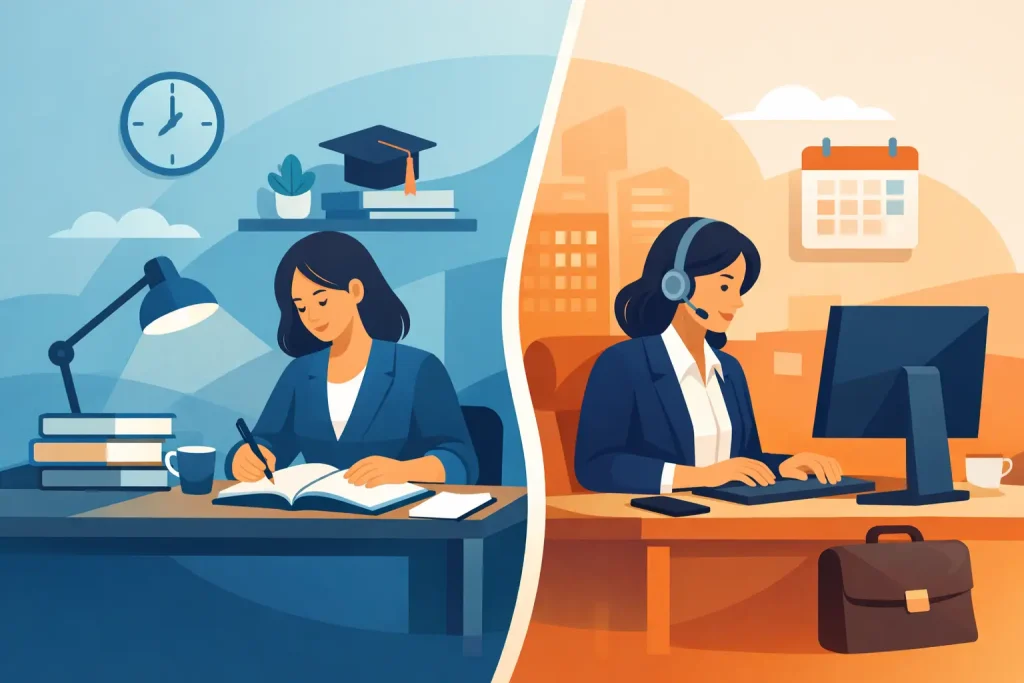
At 9 p.m., after a full workday, dinner, and a few unfinished responsibilities at home, a lot of adults ask the same question: can you study while working full time? The honest answer is yes, but not by pretending your life is empty and your calendar is wide open. It works when your education is built around real responsibilities, not around the schedule of a traditional campus student.
For working professionals, the challenge is rarely motivation. Most already know why they want to go back to school. They want stronger credentials, career mobility, higher earning potential, or preparation for leadership. The real issue is fit. If a program demands fixed daytime attendance, long commutes, or a pace that ignores work and family life, even a highly committed student can struggle.
That is why the better question is not simply whether you can do it. It is whether you can do it in a way that is realistic, sustainable, and worth the effort.
Can you study while working full time and still succeed?
Yes, many adult learners do. They succeed because they choose a learning model that respects how they already live. Full-time workers usually need flexibility more than motivation. They need coursework they can access early in the morning, during a lunch break, late at night, or on weekends. They need learning that keeps moving even when work gets busy.
Success also depends on expectations. Studying while working full time does not mean every week will feel balanced. Some weeks will be smooth. Others will feel crowded. Deadlines may overlap with projects at work, family needs, travel, or simple fatigue. A realistic program acknowledges that adult learners are managing multiple priorities and still moving forward.
There is also a trade-off to understand. Working full time while earning a degree can help you keep your income, maintain your professional momentum, and apply what you learn immediately. At the same time, it requires discipline and planning. The goal is not to make the workload disappear. The goal is to make progress possible.
What makes full-time work and study manageable?
The format matters more than many people realize. In a rigid program, your life has to bend around school. In a well-designed online program, school can fit around your responsibilities without lowering academic standards.
That difference matters for adults who cannot put their careers on hold. Flexible online learning gives students the ability to study from home, from the office, or while traveling for work. Instead of structuring life around classroom attendance, students can organize learning around the hours they actually control.
A personalized learning platform helps as well. When course materials, assignments, assessments, and communication are all housed in one place, students waste less time trying to manage scattered systems. That may sound small, but for a working adult, convenience is not a luxury. It is often the difference between staying on track and falling behind.
Practical course design also plays a major role. Adults tend to stay engaged when the work connects directly to real professional situations. Case-based assignments, applied projects, and ongoing assessment can feel more relevant than academic models designed for students with little or no work experience. When education relates to the decisions you already make at work, studying becomes easier to justify and easier to retain.
The biggest challenges adult learners face
Time is the obvious challenge, but it is not the only one. Mental energy can be harder than scheduling. Many professionals can find an hour in the evening. Finding focused energy after a demanding day is another matter.
That is why ambitious adults should avoid building a study plan around perfect conditions. You may not always feel fully rested, fully caught up, and fully motivated. A good routine accounts for real life. Sometimes progress looks like a deep study session on Saturday. Sometimes it looks like reviewing notes for 30 minutes before work.
Another challenge is guilt. Working adults often feel they are neglecting something, whether it is family time, rest, or job performance. The solution is not to try to do everything at once. It is to set clear priorities and communicate them. When the people around you understand why you are studying and what the timeline looks like, your goals feel more structured and less disruptive.
Cost can also feel like a barrier. Many prospective students assume higher education is only realistic if they stop working or take on major financial risk. That is exactly why affordability and funding support matter. For adult learners, access is about more than admission. It is about whether a degree can fit into real financial life without creating unnecessary strain.
How to make studying while working full time more realistic
Start with a pace you can sustain. One of the most common mistakes adults make is choosing a study load based on ambition alone. Ambition matters, but sustainability matters more. A manageable pace completed consistently is better than an overloaded schedule that leads to burnout.
Protect your study hours like professional commitments. If school is only something you do when everything else is finished, it will keep slipping. Many successful students use recurring weekly blocks, even if they are short. Predictability builds momentum.
It also helps to match tasks to your energy level. Use your sharpest hours for reading, writing, or analysis. Save lower-energy moments for lighter tasks such as reviewing lecture materials, checking discussion posts, or organizing deadlines. You do not need endless free time. You need a workable system.
Be honest about support. If your household, manager, or close colleagues know you are pursuing a degree, they are more likely to understand when your schedule tightens. For professionals pursuing advancement, education should not be framed as a distraction from career growth. It is often a direct investment in it.
Why online learning changes the equation
For many adults, online education is what turns a distant idea into a practical plan. It removes commuting time, reduces schedule friction, and makes it possible to continue earning while studying. That is not just convenient. It can protect financial stability while opening a path to advancement.
Online learning also widens access. Professionals who live far from campus, work nontraditional hours, or care for family members often need an option built for flexibility from the beginning. A program designed around adult learners sends a clear message: higher education should adapt to capable students whose lives do not fit a traditional mold.
At Expanding Horizon University, that access-focused model is central. Adults can pursue bachelor’s, postgraduate, master’s, and doctoral study through online delivery structured to work alongside employment and personal responsibilities. For serious learners who need quality, affordability, and flexibility in one place, that model can make long-term goals feel achievable rather than postponed.
Is it worth studying while keeping your job?
For many people, yes. Keeping your job while studying lets you maintain income, preserve work experience, and continue building your resume while you earn a credential. That combination can be powerful. You are not stepping away from your future to prepare for it. You are building it in real time.
Still, it depends on your goals. If you want a quick credential with minimal disruption, you may prioritize a shorter or more targeted program. If you are aiming for major advancement or leadership opportunities, a bachelor’s, master’s, or doctoral path may offer stronger long-term returns. The right choice depends on your industry, your timeline, and how much capacity you can realistically commit.
The strongest approach is to think beyond this month’s workload. Ask what your life could look like in two years if you start now, compared with two years if you keep waiting for the perfect time. For most working adults, that perfect time never arrives. Progress usually begins when a practical opportunity appears and you decide to use it.
If you have been asking can you study while working full time, the answer is yes – especially when your program is designed for adults with careers, obligations, and ambition. You do not need to pause your life to move forward. You need a learning path that respects where you are and helps you reach what comes next.