
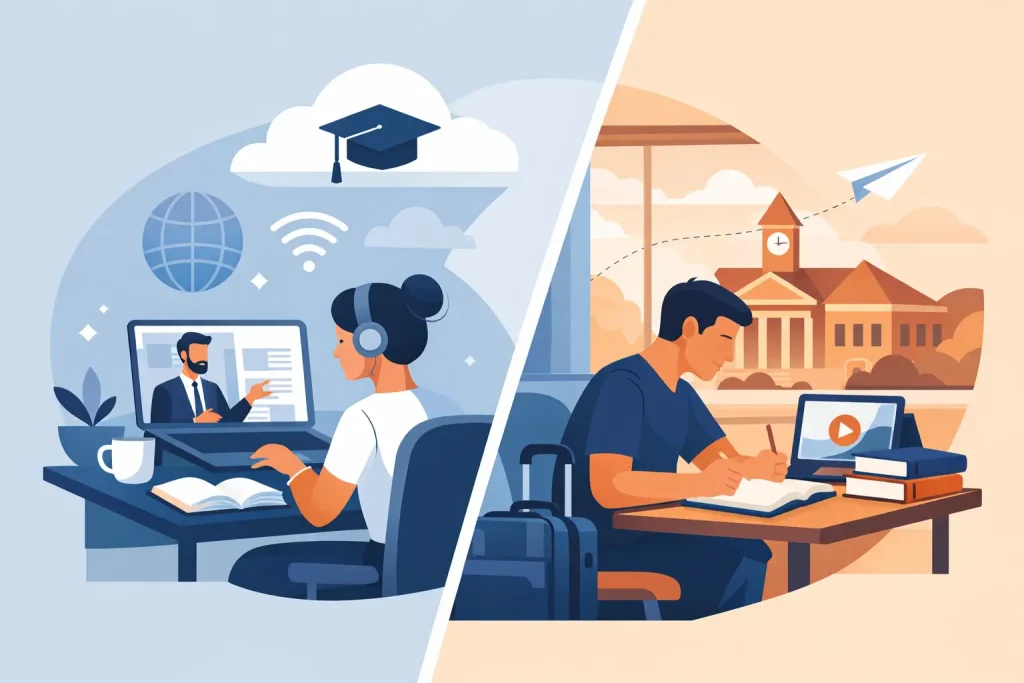
A lot of adult learners start in the same place: they know they need a more flexible path to move forward, but the language around modern education gets confusing fast. When people compare online degree vs distance learning, they often assume these terms mean exactly the same thing. They are closely related, but they are not always interchangeable, and understanding the difference can help you choose a program that truly fits your life, budget, and career plans.
For working professionals, that distinction matters. If you are balancing a full-time job, family responsibilities, and financial commitments, you do not have time to sort through vague marketing language or enroll in a program that does not match your expectations. You need clear answers about what you are earning, how you will study, and whether the format supports your long-term goals.
Online degree vs distance learning: what is the difference?
The simplest way to think about it is this: an online degree is usually the credential you earn, while distance learning is the method used to deliver education when you are not physically on campus.
An online degree program leads to a formal academic award, such as a bachelor’s, master’s, or doctoral degree, and the coursework is completed online. Distance learning is a broader category. It can include full degree programs, but it can also refer to certificate courses, diploma programs, professional development, continuing education, and other forms of instruction completed remotely.
That is why the phrase online degree vs distance learning can create confusion. One term often refers to an outcome, and the other often refers to a format. In practice, an online degree can be a form of distance learning, but not all distance learning results in a degree.
This distinction becomes especially important if your goal is promotion, leadership growth, or a career transition. If an employer requires a formal academic credential, then a short remote course may be useful for skill building, but it may not meet the requirement in the same way a degree program does.
Why the difference matters for adult learners
If you are returning to school after years in the workforce, you are probably not enrolling for the experience alone. You are enrolling for progress. That might mean qualifying for a management role, entering a new field, strengthening your credibility, or reaching a personal milestone you had to postpone earlier in life.
In those situations, the key question is not just whether a program is remote. The real question is what the program delivers. Does it provide a recognized degree? Is the curriculum designed for career application? Can you complete it without stepping away from your income? Does the structure respect the fact that you already have major responsibilities?
Distance learning can absolutely be valuable. It offers access, convenience, and scheduling freedom that traditional campus study often cannot match. But if your goal depends on earning a bachelor’s, master’s, or PhD, then you should focus on online degree options within the wider distance learning landscape.
Online degree vs distance learning in real-world terms
Think about two students.
The first enrolls in a remote professional development course to strengthen data analysis skills. The course is completed from home, includes online assignments, and may improve day-to-day performance at work. That is distance learning.
The second enrolls in a fully online master’s program, completes structured modules, submits ongoing assessments, and graduates with a formal postgraduate degree. That is also distance learning, but more specifically, it is an online degree program.
Both students are studying remotely. Both may gain valuable outcomes. But the scope, credential, and career impact can be quite different.
This is why serious applicants should read beyond headlines and promotional labels. The word online tells you how you will study. The word degree tells you what you will earn. The phrase distance learning tells you that teaching happens away from a physical classroom, but it does not always tell you the level of the final qualification.
What employers usually care about most
Many prospective students worry less about terminology and more about credibility. That is a smart concern.
Most employers are not fixated on whether you studied through a campus classroom or an online platform. What they usually care about is whether the credential is relevant, whether the learning is rigorous, and whether you can apply what you learned on the job.
For adult learners, this is encouraging. A well-structured online degree can be highly attractive because it demonstrates more than academic achievement alone. It can also show discipline, time management, initiative, and the ability to perform under pressure while maintaining professional responsibilities.
That said, not every remote program has the same value. If career advancement is your goal, look closely at the level of award, the practical focus of the curriculum, the learning model, and whether the institution is designed to serve serious students rather than casual hobby learners.
How to choose the right path for your goals
The best choice depends on what you need the program to do for you.
If you want to build a single skill quickly, a distance learning course or short program may be enough. If you need a formal academic credential for promotion, professional standing, or advanced opportunities, an online degree is often the stronger path.
It also helps to think about time horizon. Some learners need a short-term boost. Others are making a long-term investment in their future earning power and leadership potential. A short remote course can help you adapt to immediate workplace needs, but a degree can reshape your career trajectory over time.
You should also consider how the program fits your routine. Flexibility is not just a nice feature for adult learners. It is often the deciding factor between finishing and dropping out. Programs built for working professionals usually make a real difference here, especially when coursework, assessments, and support systems are structured around busy schedules.
At Expanding Horizon University, this is exactly the kind of student-centered model many adults are looking for: education designed to fit around employment, family life, and professional ambition rather than forcing students to put everything else on hold.
Questions to ask before you enroll
Before you commit to any program, take a practical approach. Ask what credential you will receive at the end. Ask how courses are delivered and whether the format is fully online. Ask how assessment works, how often you will interact with faculty or learning systems, and how the program supports students who are managing work and family obligations.
You should also ask yourself a few direct questions. Do I need a recognized degree, or do I need a shorter learning experience? Am I trying to qualify for a new level of responsibility? Will this program still matter to me three or five years from now?
These questions can prevent costly mistakes. A program that sounds flexible but lacks clear academic outcomes may not move you toward the result you want. On the other hand, a strong online degree can create momentum that extends well beyond graduation.
The trade-off: speed vs long-term value
There is no one-size-fits-all answer in the online degree vs distance learning conversation because both options can serve a purpose.
Shorter distance learning programs are often faster and may cost less upfront. They can be a practical solution if you need immediate knowledge in a focused area. The trade-off is that they may not carry the same weight as a full degree when employers are evaluating candidates for advancement or leadership roles.
Online degree programs usually require a larger commitment of time and effort. But they also tend to offer broader academic depth, a clearer credential outcome, and stronger alignment with long-term career growth. For many adult learners, that added commitment is worthwhile because it creates opportunities that a short course alone may not open.
What confident students understand
The most successful adult learners do not just ask, Can I study remotely? They ask, What path gives me the best return on my effort?
That is the smarter question. Remote study is now widely accepted, but format alone is not the deciding factor. The real value lies in choosing a learning option that matches your career goals, your schedule, and the level of recognition you need.
If you are comparing online degree vs distance learning, start by defining the outcome you want. If you need flexibility with formal academic progress, an online degree may be the better fit. If you need a narrower, faster learning experience, distance learning in the form of a short course may be enough for now.
Either way, your education should move your life forward, not make it harder to manage. The right program will respect your responsibilities, support your ambition, and help you build a future on terms that work for you.