
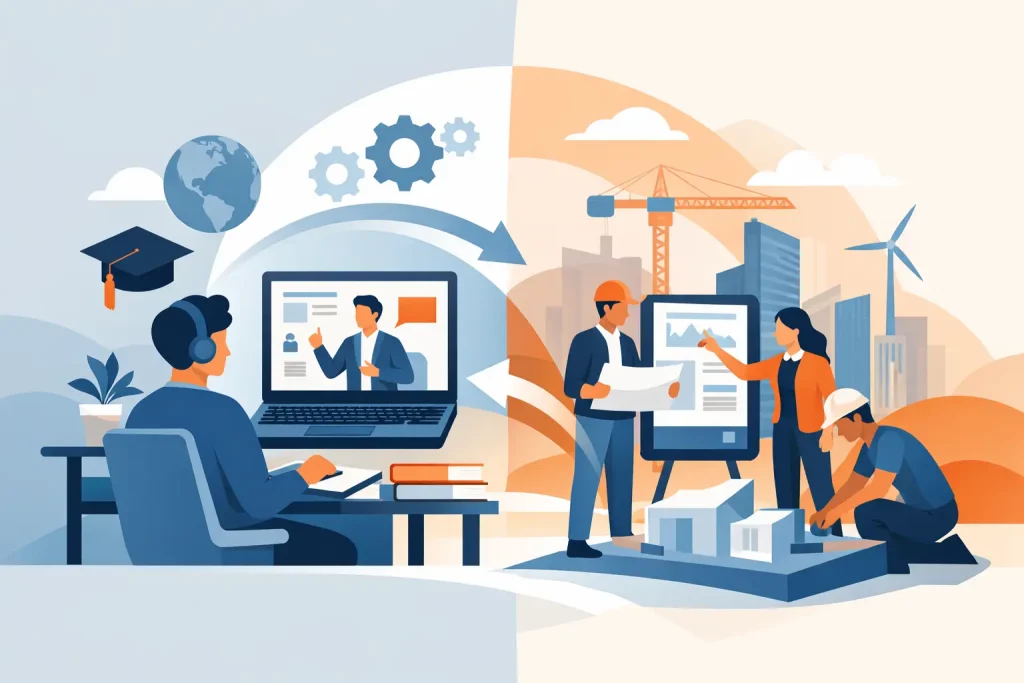
A discussion post and a timed quiz can measure progress, but they do not always show what you can actually do on the job. For many adult learners, that gap matters. If you are investing time, money, and energy into an online degree with real world projects, you want coursework that connects directly to the work you hope to do next, not just the theories you need to memorize.
That is exactly why project-based online learning has become such a practical choice for working adults, career changers, and professionals aiming for leadership roles. It allows you to apply concepts as you learn them, test your thinking in realistic situations, and graduate with more than credits on a transcript. You build evidence of skill, confidence in your decision-making, and a clearer sense of how your education fits your career path.
Why an online degree with real world projects stands out
A flexible schedule is often the first reason students consider online education. They need a program that respects work hours, family obligations, and financial realities. But flexibility alone is not enough. Adult learners also need assurance that their degree will lead somewhere meaningful.
That is where real-world project work changes the experience. Instead of treating learning as something separate from professional life, project-based courses bring the two closer together. A marketing student might build a campaign proposal. A business student might solve an operations problem using actual performance data. A student in education, healthcare administration, information technology, or leadership may work through scenario-based assignments that mirror the kinds of decisions professionals make every day.
This matters because employers increasingly value proof of applied skill. They want to know whether a candidate can analyze information, communicate clearly, solve problems, and complete work in context. A degree that includes realistic projects helps you practice those abilities before you need to demonstrate them in a new role.
What real-world projects actually look like in online learning
Not every project-based program works the same way, and that is worth understanding before you enroll. In strong online programs, projects are not random add-ons. They are built into the learning design so that assignments reflect the kinds of situations students are likely to face in the workplace.
Sometimes that means case studies based on realistic organizational challenges. Sometimes it means creating reports, presentations, implementation plans, research-driven recommendations, or strategic analyses. In more advanced programs, projects may ask students to integrate knowledge across multiple topics and defend their decisions with evidence.
For adult learners, this structure often feels more relevant than education built mostly around exams. If you already have work experience, project-based assignments give you room to connect your background with new knowledge. If you are entering a new field, they help you start thinking like a practitioner, not just a student.
There is also an important trade-off to keep in mind. Real-world projects usually require more sustained effort than short quizzes. They ask for planning, reflection, revision, and time management. For busy professionals, that can be demanding. The advantage is that the work often feels more worthwhile because you can see how it applies beyond the classroom.
The career value of project-based online degrees
A credential opens doors, but outcomes often depend on how well you can translate your education into workplace value. An online degree with real world projects can make that easier because it gives you concrete experiences to talk about during interviews, performance reviews, and promotion discussions.
When hiring managers ask how you approach problem-solving, lead a team, manage a process, or evaluate data, it helps to draw from substantial academic work that mirrors professional challenges. You are not only saying that you completed a degree. You are showing that your degree required you to think critically, produce work under deadlines, and apply ideas in practical settings.
This can be especially valuable for students who are changing industries or seeking advancement without stepping away from their current job. You may not yet hold the exact title you want, but project-based coursework can help you develop the language, frameworks, and confidence needed to pursue the next opportunity.
For many adult students, the benefit is not limited to future job applications. The impact can show up immediately in their current role. A course project may sharpen how you structure proposals, analyze business issues, communicate with stakeholders, or evaluate performance. In that sense, practical online education can support both present-day effectiveness and long-term mobility.
Why this model works well for adult learners
Traditional higher education often assumes students can organize their lives around class schedules, campus expectations, and fixed routines. Adult learners know that reality looks different. A realistic program has to meet you where you are while still moving you forward.
That is why practical, flexible online learning is such a strong fit for nontraditional students. It allows you to study from home, from the office, or whenever your schedule permits. At the same time, project-based learning keeps the experience focused on results that matter in professional life.
This balance is powerful. Flexibility makes education accessible. Real-world application makes it worthwhile. Together, they create a learning environment that supports people who cannot afford to pause their careers but still want recognized credentials and meaningful skill development.
Students also tend to stay more engaged when assignments feel relevant. Reading theory has value, but adults are often motivated by direct connection. When you can see how a lesson applies to management, operations, strategy, education, technology, or organizational leadership, it becomes easier to stay committed through a demanding schedule.
How to choose the right online degree with real world projects
If you are comparing programs, look beyond broad promises about career readiness. Ask how practical learning is actually delivered. A credible program should be able to show how projects fit into courses, how students are assessed, and how the curriculum supports both academic quality and workplace relevance.
It also helps to evaluate whether the learning model fits your life. A good program for working adults should offer convenience without lowering expectations. You want structure, support, and clear milestones, but you also need the freedom to continue earning, parenting, and managing daily responsibilities.
Affordability matters as well. A degree should expand opportunity, not create unnecessary strain. For many students, the right choice is a program that combines accessible tuition, available funding support, flexible online delivery, and practical coursework that feels connected to real career outcomes.
Another useful question is whether the program serves students at your stage. Bachelor’s students may need foundational projects that build confidence and workplace habits. Master’s and doctoral students may need more advanced assignments tied to leadership, strategy, research, or complex decision-making. The best fit depends on your goals, your experience, and how quickly you want to apply what you learn.
At institutions such as Expanding Horizon University, this practical approach is especially relevant because the student population includes working adults who expect education to respect their time and strengthen their career trajectory. That expectation is reasonable, and it should shape the way online programs are designed.
What credibility really means in online education
Some prospective students still worry that online learning will be seen as less serious than traditional study. That concern is understandable, especially for people who are making a careful investment in their future. But credibility today is shaped by much more than delivery format.
What employers and professionals often care about is whether the program is structured, whether the curriculum is relevant, and whether students can perform. An online degree built around applied projects, ongoing assessment, and realistic scenarios can demonstrate academic seriousness in a very clear way. It asks students to do substantial work, not just passively consume content.
This does not mean every student needs the same kind of project experience. Someone pursuing advancement in business may need strategic and analytical assignments. Someone in education or public service may benefit from planning, evaluation, and policy-focused work. The strongest programs understand those differences and align coursework with the demands of the field.
If your goal is advancement, credibility comes from the combination of recognized study, disciplined effort, and practical application. That combination is exactly what many adults need from modern higher education.
Education that moves with your life
For ambitious adults, the best degree is not simply the one that fits into a schedule. It is the one that helps turn your current responsibilities into a foundation for future growth. An online degree with real world projects offers that kind of momentum because it respects where you are while preparing you for where you want to go next.
If you are ready to build credentials, strengthen your professional value, and learn in a way that feels connected to real work, choose a program designed for action, not just attendance. The right education should move with your life and help your next step feel closer than it does today.